


.webp)


Meteors regularly blaze through Earth’s atmosphere with potentially devastating effects. Now scientists reveal that they used kilometers of fiber optics to analyze shockwaves from a NASA spacecraft returning to Earth, suggesting that existing telecom fiber networks might help shed light on the natural cosmic impacts that constantly pepper our planet.
Approximately 100,000 tonnes of meteors fall on Earth each year at hypersonic speeds—up to roughly 262,000 kilometers per hour. Scientists would like to analyze meteor trajectories in greater detail to learn more about the risks they might pose, but the generally unpredictable nature of meteors makes that difficult.

NASA image of a meteorite burning in the atmosphere.
Fiber Optical Cables Provide Solutions
A chance to remedy that problem came with the return of NASA’s Origins, Spectral Interpretation, Resource Identification, and Security-Regolith Explorer (OSIRIS-REx) mission. Launched in 2016, OSIRIS-REx touched down on the asteroid Bennu in 2020 and loaded samples it collected into a capsule that returned to Earth, safely landing at the U.S. Department of Defense’s Utah Test and Training Range on 24 September 2023. The known timing and trajectory of this return gave scientists the rare opportunity to deploy arrays of sensors to analyze the capsule during its descent.
In a new study, researchers at Los Alamos National Laboratory, in New Mexico, and Colorado State University in Ft. Collins used fiber optic cables to detect acoustic waves from OSIRIS-REx as it streaked through the sky. They employed a strategy known as distributed acoustic sensing, which previous work found could detect seismic waves from earthquakes and moonquakes.
What is Distributed Acoustic Sensing?
Distributed acoustic sensing transmits laser light pulses through optical fibers and analyzes the intensity of the signals reflected back from imperfections in the fibers. Slight stretching or contracting of the fiber from acoustic waves can alter these reflected signals.
Over the past decade, advances in distributed acoustic sensing have expanded it beyond niche uses in boreholes to other applications. “Distributed acoustic sensing is generally used to detect vibrations traveling in solids, such as the earth, or in liquids, such as in the ocean, but it has less often been used for acoustic waves traveling in air,” says Carly Donahue, a physicist at Los Alamos.
Before OSIRIS-REx’s return, the scientists deployed 12 kilometers of fiber-optic cables along dirt roads between two sites near Eureka, Nevada. They also made use of six pairs of seismometers and infrasound sensors to validate the accuracy and reliability of the distributed acoustic sensors.
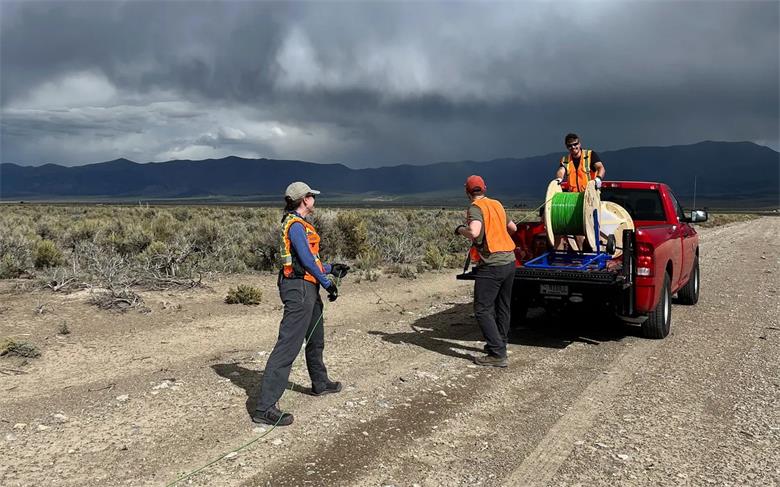
Researchers scrambled to assemble a fiber-optic-cable network to try to detect the OSIRIS-REx spacecraft’s return to Earth in 2023. Image shot by Elisa McGhee
“Since we only learned about the opportunity five months before the arrival, we had to hurry to pull a team together, make a plan, and pull together all of the required equipment,” Donahue says. “Eureka, Nevada, is known as the ‘friendliest town on the loneliest road in America’ and is nowhere near a large city. Therefore, we needed to be prepared to bring all necessary equipment ourselves.”
Previous research found that burying optical fiber reduces the noise that distributed acoustic sensors can experience from wind. However, despite the fact that much of the fiber was ordered months in advance, it arrived only a few days before the experiment began. This limited time meant that “it was not feasible to bury it, so we laid it out on the surface,” Donahue says.
Tests of the sensors “detected a variety of signals from moving vehicles, airplanes, and individuals, raising concerns that these background signals might completely obscure those from the space capsule,” Donahue says. To mitigate this, the scientists coordinated with state police to temporarily halt traffic during the reentry window.
“Recording a space capsule reentry on optical-fiber sensors such as distributed acoustic sensors had never been attempted before, so we were incredibly anxious that we would travel out to Nevada from New Mexico and have nothing to show for our results,” Donahue says. “We were thrilled that not only did we detect the reentry at both locations, we also recorded a rich dataset which gave us insight to how the sonic boom evolved as it propagated.” The seismometers and infrasound sensors recorded similar readings.
Future distributed acoustic sensing campaigns analyzing objects entering Earth’s atmosphere may leverage either preexisting telecom fiber or fiber optics designed to specifically measure sonic booms or seismic waves, Donahue suggests.
(Source from IEEE Spectrum, edited and reprinted by Fibermart)





No comments have been posted yet.